
It's a privilege

Travelogue
As I mentioned in the previous post, this past week was a travel week for us. We had always planned to travel north while we were in San Diego and last week was perfect as it was the one week we could not stay in our North County rental. We spent most of our time in San Francisco and in and around Santa Cruz seeing lots of family and friends, having lots of good food and good wine, and marveling at the Pacific, the coastal and inland landscapes, and our good fortune to be in the position to enjoy all of those things. Several of our family members are having health challenges so it was good to catch up and support them as we could. Again it was our good fortune—our privilege—to be able to do that. We didn’t take nearly enough pictures but here are a few to look at.
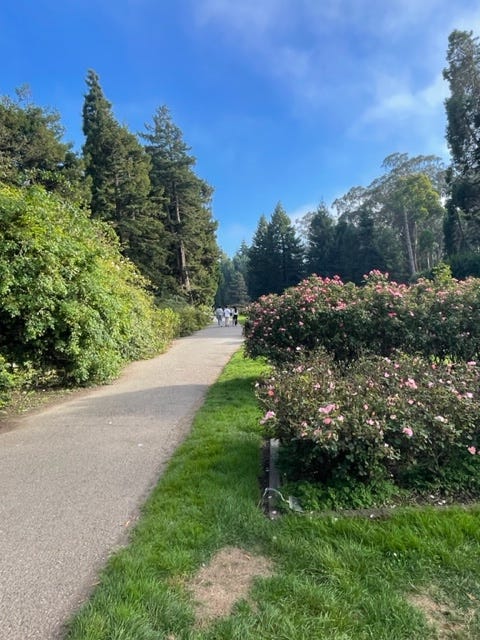
The rose garden in Golden Gate Park

A slightly blurry view of the San Francisco skyline at dusk from Twin Peaks.
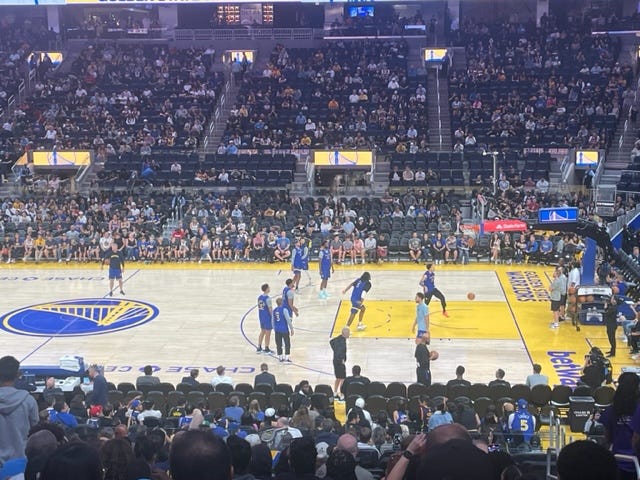
At the Golden State Warriors’ pre-season open practice.
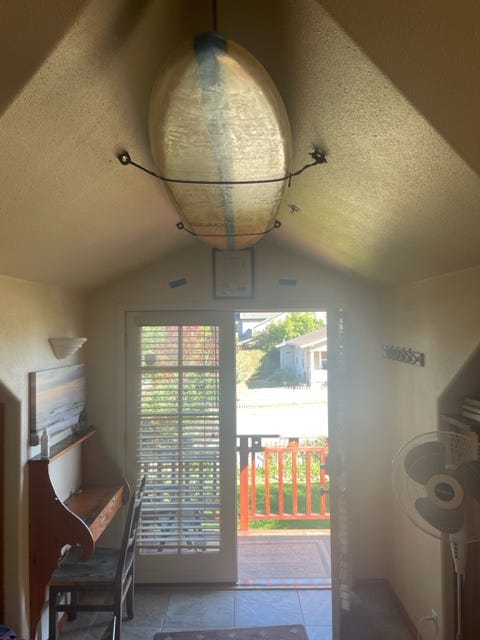
A view looking out of our adorable Santa Cruz AirBnB.
Privilege. That’s a word that has taken on new connotations in recent years, specifically as it is used to refer to male privilege, cis privilege, and white privilege. As a white cis male, I recognize that I am a beneficiary of all of these forms of privilege and many others, including a comfortable middle-class suburban upbringing and a stable family system that was pretty damn functional. Sharon (mixed race and cis female) does not benefit from any of those but she did benefit from certain forms of privilege (access to top-notch education, child of a noted scholar) that landed her along with me on this three-month sojourn in her home state with the time and resources to enjoy our trip and connect with her broader family in ways she hasn’t been able to do in some time. We reflected on our good fortune over a terrific wine tasting in Paso Robles on our way back the other day (if that isn’t a privileged sentence, I don’t know what is!). The stark contrast between our circumstances and others around the world—Gaza in particular is on our minds this week—humbles us tremendously.
Psychologue
I’ve also been studying privilege in a different sense for the past few years, the sense of privileged information. Several models of early cognitive and language development rest strongly on the assumption that word labels and other forms of information are conventional, meaning simply that this information is one that is used by all (or nearly all members) of a community or culture. So if a child doesn’t know what to call an object, they can safely assume that a parent, teacher, or another child can teach the child the correct term. Eve Clark did classic work on the conventionality of language and work by my colleagues Gil Diesendruck and Lori Markson (among others) has demonstrated quite convincingly that children typically make this assumption of conventionality during word learning and similar tasks.
However (you knew that was coming, right?) not all information is conventional and meant to be shared with others. For adults issues like lawyer-client or doctor-patient confidentiality or information gained from espionage are examples of information or information exchanges that are not meant to be shared with everyone, and there are possible negative repercussions for making public information that was not meant to be public. Celebrity gossip and other forms of rumor also fit here. For children, things like surprise parties, the contents of a wrapped present, and even swear words are things they are frequently told to not share with others. I mean, think of how embarrassed parents get when a child innocently repeats something like “daddy had too much to drink last night” simply because that information was not meant to be shared but a child might have assumed it was conventional!
So when do children begin to learn the distinction between conventional and privileged information? This is a question that my former grad students Lani Girgis, Rachel Stevens, and I have investigated. First we gave adults definitions of conventional (can and should be shared) and privileged information (can but shouldn’t usually be shared) list of about 40 items and asked them to rate these items on a scale with privileged on one end and conventional on the other. We then took 5 of the items at each that were rated at each end of the scale (the most privileged and most conventional) and created simple vignettes that would be familiar to young children. We read these vignettes to 3-, 4-, and 5-year-old children and adults and asked in each case whether one character should share that information with another. If it is true that children assume that this information is conventional then they should have a bias to think that information should be shared regardless of its content. A graph of the results are shown here:
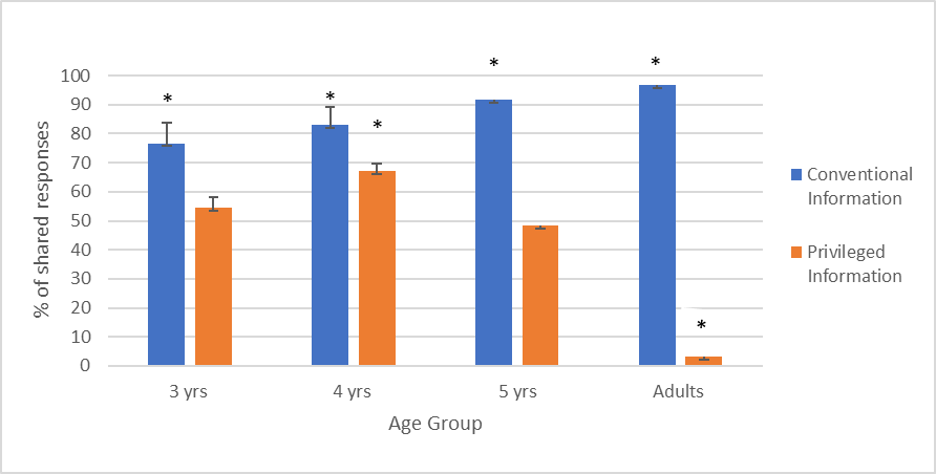
As the graph shows, all age groups thought that the conventional items should be shared at least 75% of the time but only adults thought that the privileged information should not be shared most of the time. In fact, the adults were close to perfect in their agreement that the conventional items should be shared and privileged items should not be shared which corroborated the results from the first study. The 3- and 5-year-olds responded to the privileged information at a rate not different from chance (50%) while the 4-year-olds thought the privileged items should be shared more often than chance (67%)! We determined that this was because one of the privileged items was whether someone should tell a girl a password to a boy’s clubhouse, and nearly all of the 4-year-old girls thought they should! Gendering that item was not a particularly good choice on our part. Despite this children showed a bias to 1) share all information but gave significantly more share responses to conventional than privileged information suggesting that even young children have some idea that not all information should be shared. However it appears that this is not until at least five years of age when this distinction begins to become solidified. We are currently revising the paper that reports this study and expect it to be accepted for publication in the near future.
Enjoying Trivialogue? Hit the button below to subscribe and get each post delivered directly to your email inbox!
Trivialogue: Today’s questions are on inappropriate information sharing!
Joe Biden dropping an F-bomb in 2010. Baseball broadcaster Thom Brennaman using a homophobic slur in 2020. Former New Zealand Prime Minister Jacinda Ardern calling the leader of the opposition ACT party a disparaging name. These people were all caught saying these things by what two-word slangy term for what item that (unknown to them) was operational at the time.
Julian Assange, the founder of Wikileaks, is still fighting extradition to the United States on charges of violating the Espionage Act of 2017 for releasing a variety of sensitive information through Wikileaks. In what country is Assange currently detained as his extradition is being contested? Hint: he’s not in Ecuador anymore.
What 1991 song contains the lines “Oh no I’ve said too much/I haven’t said enough”? This song won 1992 Grammys for Best Short Form Video and Best Pop Performance by a Duo or Group with Vocals.
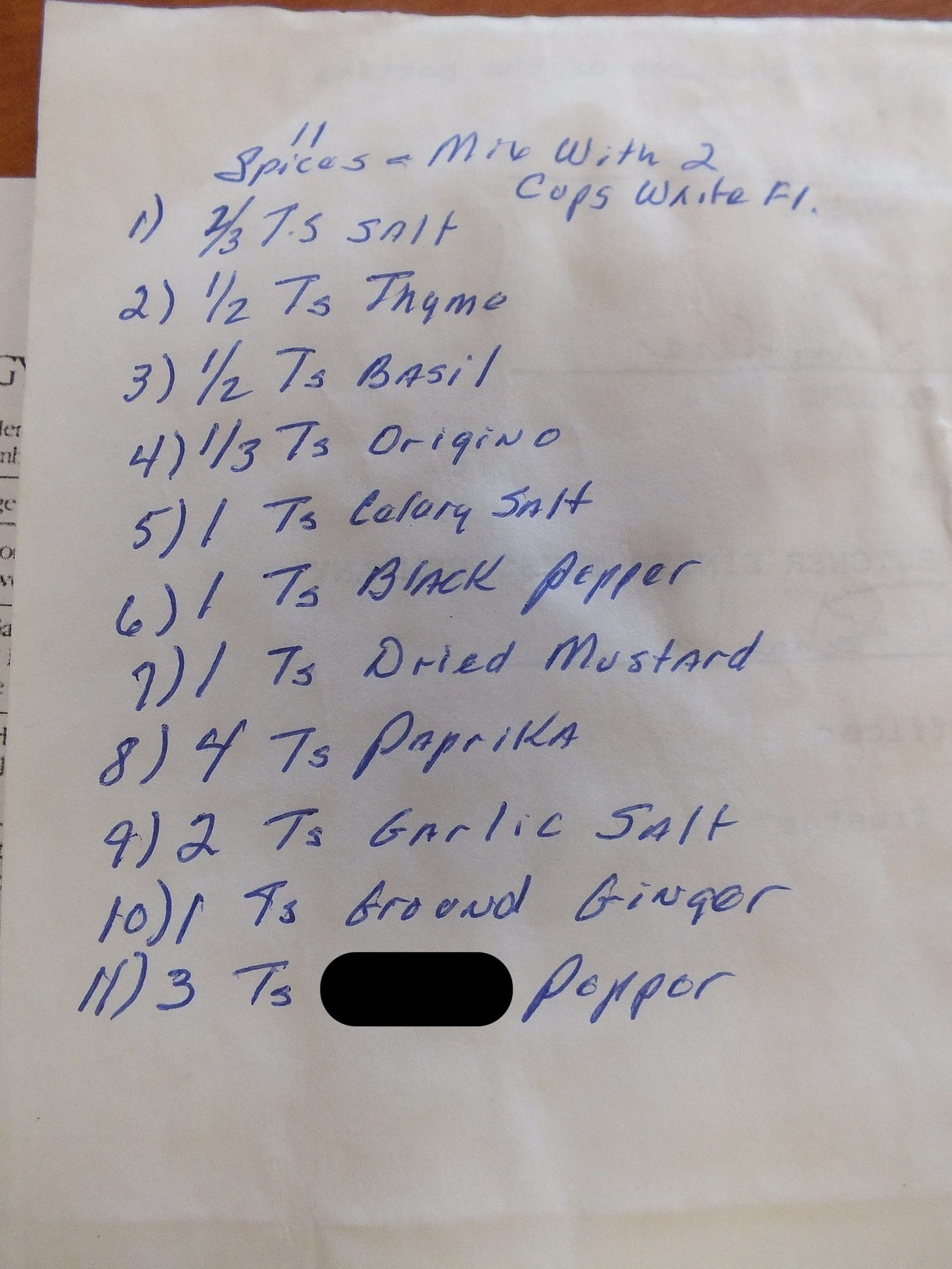
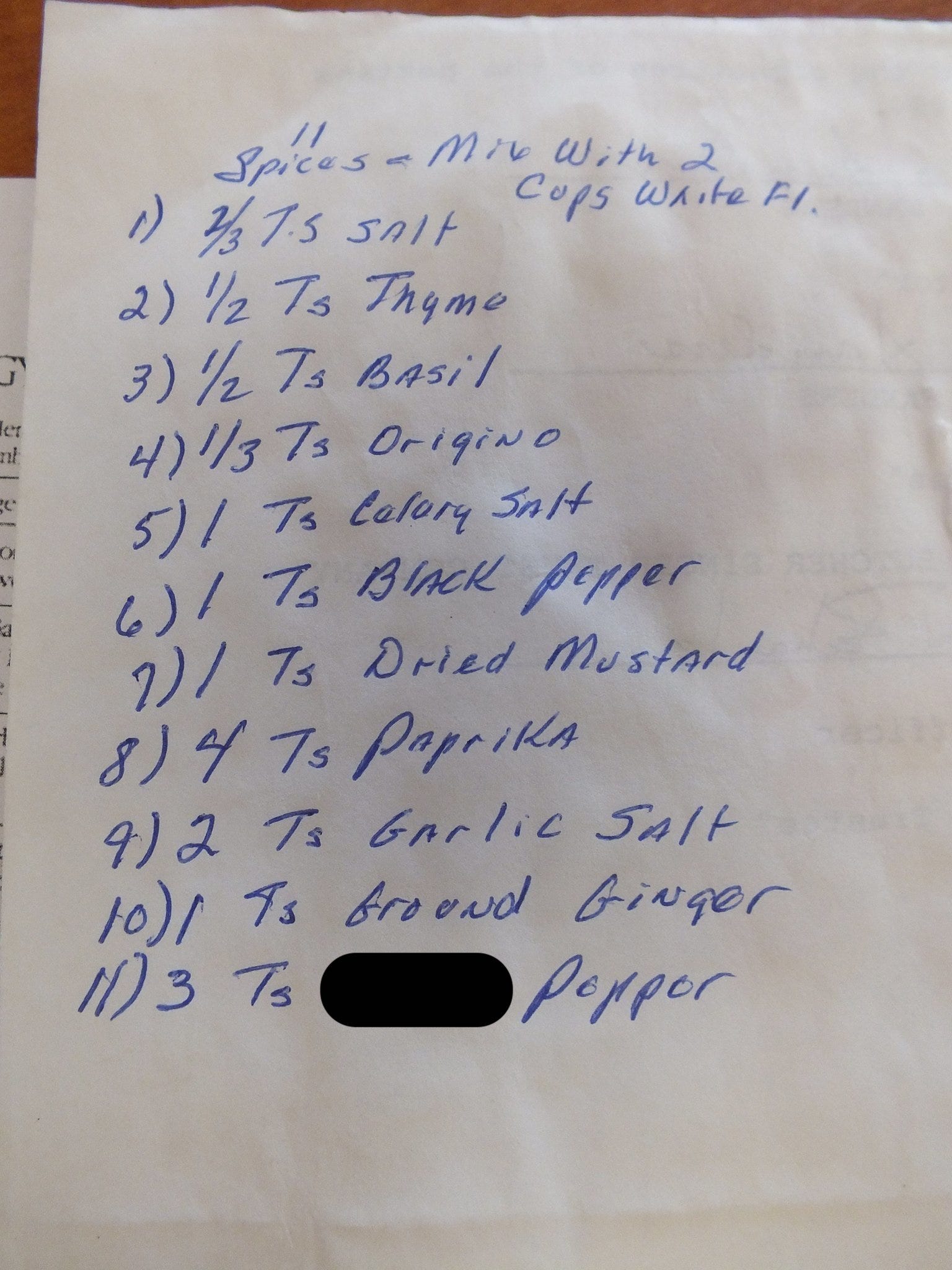
The slightly redacted photo below shows what may be the original secret recipe for Kentucky Fried Chicken’s “11 herbs and spices” though KFC denies that it is. Colonel Sanders’ nephew Joe Ledington purportedly found this on the back of a family member’s will. What word is redacted from the photo? According to Ledington, “I call that the secret ingredient…Nobody knew how to use it.”
The rise and fall of biotech company Theranos is well-known, even inspiring the Netflix miniseries “The Dropout”. All employees and visitors to Theranos were required to sign an NDA, in theory to protect Theranos’ trade secrets. What does the initialism NDA stand for?
Scroll down a bit for the answers:
Hot mic (or hot mike). Always make sure the mic AND the speakers are shut off before running your mouth. The Brennaman case became meme-able when his attempt at an apology was interrupted by a home run by Nick Castellanos. He was deservedly suspended almost immediately afterwards and has not broadcast an MLB or NFL game since.
England: Assange has been detained in HM Prison Belmarsh in London since April 2019 when his asylum in Ecuador was revoked. Assange, a native of Australia, actually ran for a seat in the Australian Senate in 2013 representing the (surprise) Wikileaks Party but was not elected. I have very complicated feelings about Assange and Wikileaks and would be interested to hear your takes.
Losing My Religion by R.E.M. was the band’s biggest hit by far with the Grammy wins, multiple MTV Video Awards, and over 1.1 BILLION views on YouTube. Let’s add a couple to that total. I have been a fan of their work since the early 80s, and it’s always somewhat disconcerting but rewarding to see a band that toiled in relative obscurity hit it big.
4. White: White pepper is made from the same fruit as black pepper and is harvested at the same time. Whereas black pepper is dried immediately after harvesting, white pepper is soaked after harvest so the outer layer comes off leaving the smooth white fruit below which is then dried before packaging. White pepper has a distinctly different flavor from black pepper which I find both brighter and with more umami than its more common variant.
5. Non-Disclosure Agreement: NDAs are common in a variety of legal, technical, and creative contexts. They are primarily designed to prevent the sharing of intellectual property or other 'trade secrets’ when employees leave one company or band or other enterprise for another. In the case of Theranos, however, the NDAs were most frequently used to cover up their fraudulent claims about the effectiveness of its technology. Former Theranos CEO Elizabeth Holmes was found guilty of wire fraud and conspiracy to commit wire fraud and earlier this year began serving an 11-year sentence in a federal prison in Texas.
How’d you do on today’s questions? Let me know in the comments!